Sacred Hong Kong

Living Heritage

A showcase of new technologies for documenting and presenting Hong Kong’s sacred artefacts: photogrammetry, interactive 3D viewers and curated virtual tours.

The Social Life of Artefacts

A temple bell, a soul tablet, a plaque carried twice across the harbor: each has a history that extends beyond the venue in which it is housed. The databases used on this site catalogue places, but the objects within them—and the relationships sustained through their use—remain largely undocumented.

This section introduces a digital record format for documenting artefacts and the spaces they inhabit. Each record will bring together an object’s material characteristics, location, provenance, custodianship, and ritual use. Following Kopytoff’s biographical approach, it will trace who made or donated the object, who cares for it, how it has moved or changed, and when and why it becomes significant in communal life.

Digital documentation will combine:

  • High-resolution photogrammetry to record the three-dimensional forms and surface details of sculptures, ceramics, and carved reliefs.
  • Interactive web viewers, such as Sketchfab or 3DHOP, to present models of artefacts and ritual spaces for users to rotate, examine, and explore.
  • Curated narratives, photographs, and contextual records to connect these models with the people, practices, and histories that give them meaning.

Together, these records will form a curated virtual tour of Hong Kong’s living heritage. By presenting artefacts through their biographies and continuing use, the section will support their documentation, interpretation, and public appreciation while retaining their connections to the communities that care for them.

The Four Celestial Messengers: An Animated Yao Painting

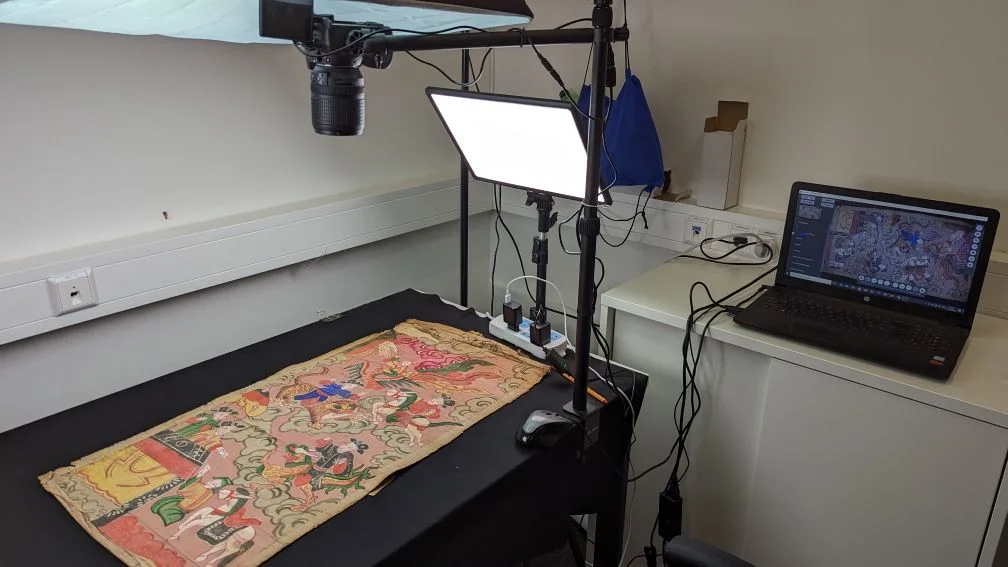
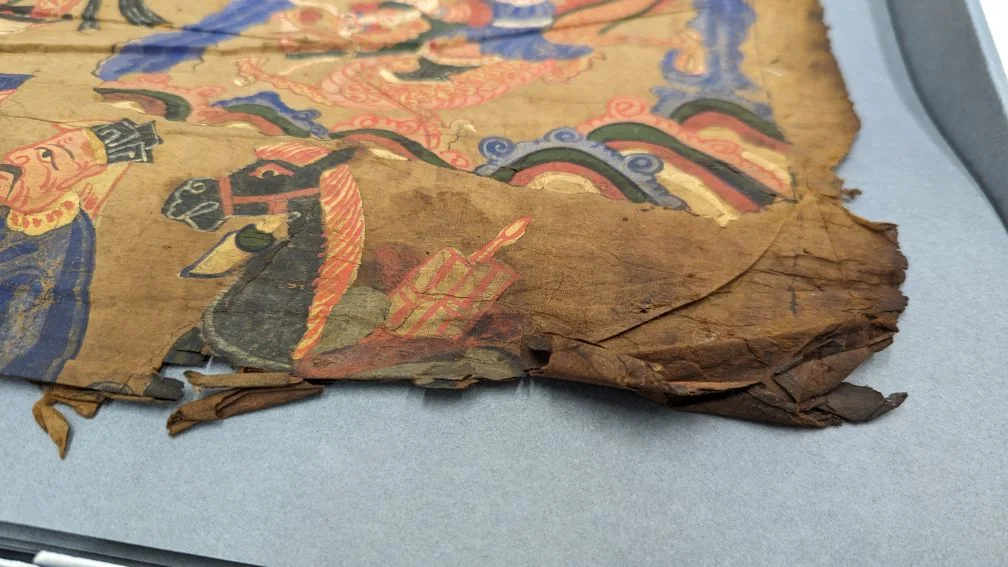
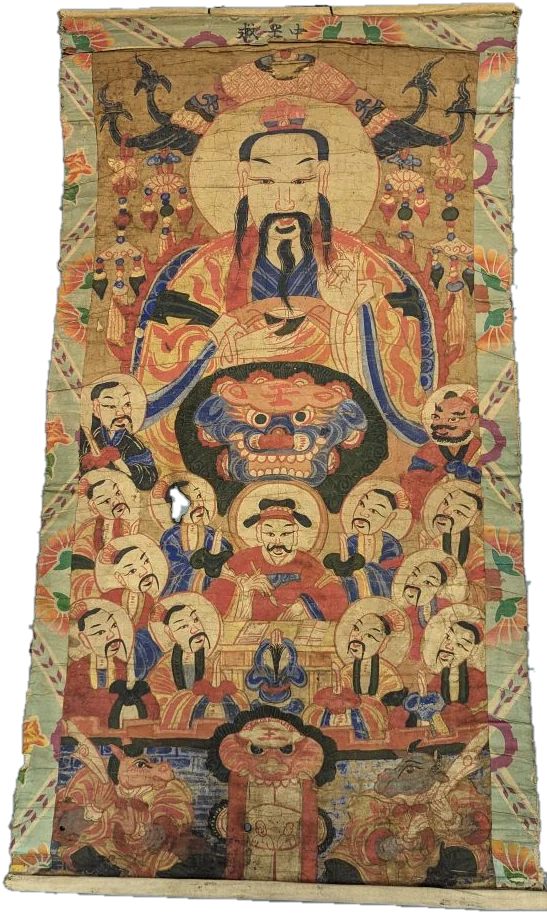
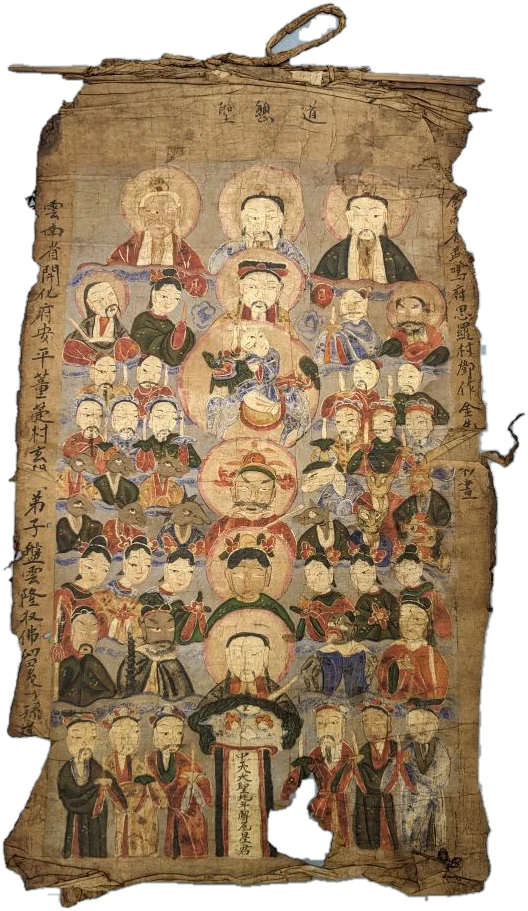
In July 2023 the author photographed manuscripts and painted scrolls from the Yao collection of the Centre for Asian and Transcultural Studies (CATS) at Heidelberg University. The CATS Library describes the collection as Daoist ritual manuscripts of the Yao, 220 manuscripts and 10 image scrolls (CATS Library n.d.). The photography formed part of a Heidelberg digitization project funded through a Sun Yat-sen University programme on overseas Chinese folkloristic artefacts (Yao Dao Project n.d.).

One of the painted sheets shows four riders crossing blue clouds: a figure on a phoenix, one on a white horse, one on a tiger and one on a dragon with a flame-like crest. They are the Four Celestial Messengers. In the reading the author has drawn from fieldwork, the messengers carry invitation summonses that gather all the celestial guests mandated to join a ceremony.

The Four Celestial Messengers, animated from one photograph of the painting. Painting: Yao Manuscript Collection, CATS Library, Heidelberg University. Photograph and animation: Joseba Estévez.

Open in a full window

How the film was made

The film starts from one photograph of the painting, 567 by 1,008 pixels. A generative video model (MiniMax) animated the riders and their mounts in clips that were joined at nine seconds. The clouds were then rebuilt on a separate layer. All 360 frames were aligned, a cloud mask was drawn from the pixels that stay cloud-blue throughout, and a circulating cloud motion was composited behind the figures. The result runs for 15 seconds without sound.

Sources
  1. CATS Library. n.d. “East Asia Section: Chinese Studies.” Collections, CATS Library, Centre for Asian and Transcultural Studies, Heidelberg University.
  2. Yao Dao Project. n.d. “Research.” The University of Hong Kong.

Jiu Kong, “Lord Yao”: A Lanten Yao Mask

This wooden mask of the Lanten Yao (Mun) was carved by Mr. Bounchan of Namdee Village. It is used in rituals that invite flowers, which symbolize the ancestors being born, that is, becoming children. The mask represents Jiu Kong, “Lord Yao,” the ninth son of the Jade Emperor, and it is worn by a Taikong, a ritual expert.

The viewer is built from one video of the mask on a clear stand against a white wall. One hundred and eighty frames from a single revolution, about 2° apart, were cut out from the wall and the stand by automated segmentation, with the mouth and its vertical teeth kept whole. The eye slits and the gaps between the teeth stay open, so the background shows through them. The frames were brightened, and their color, contrast and luminosity matched from one frame to the next. The mask is held upright on the axis of its horn, and the pictures between neighbouring frames are computed from the motion measured between them, so that the turn looks even. Every image in the viewer comes from the video.

Drag to turn, or use the buttons and arrow keys. The plus and minus buttons, the mouse wheel and a two-finger pinch zoom in and out. The mask belongs to the author’s private collection.

A carved wooden mask with a tall striped horn on its head, open eye slits and a wide mouth with vertical teeth

Drag to turn. Zoom with the plus and minus buttons or the mouse wheel.

Open in a full window

Reference: masks in ritual use

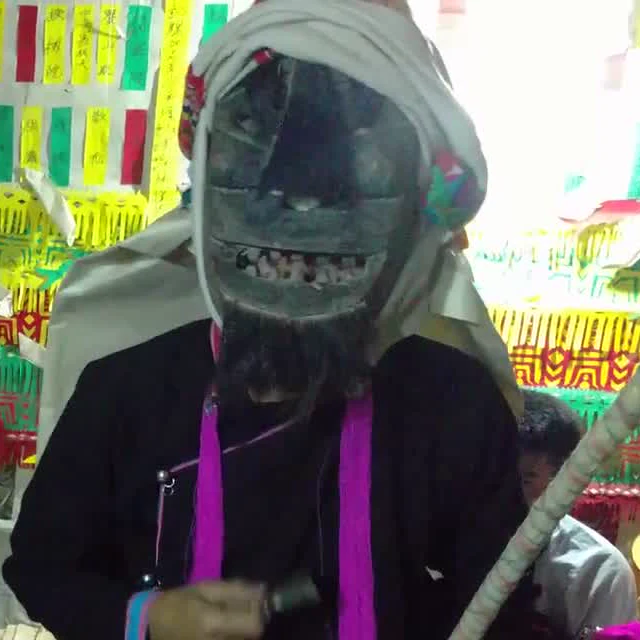
Video recorded on 23 December 2018 during a ritual, shown as a reference for how masks of this kind are worn. The sound is included.
A performer in a dark jacket with a pink sash and a white headcloth wears a grey mask with bared teeth in front of a colorful ritual altar
Detail from the video: a mask in use.

A Lanten Yao Ordination Ritual in 360°

This reconstruction presents several moments from a double Daoist ordination as Daokong (“priest”) and Taikong (“master”), held in the Highlands of northern Laos in December 2018 and documented by Joseba Estévez. During the ceremony, the house becomes a temporary Celestial Yamen: altars line its walls, while the ceiling represents the sky, decorated with celestial bodies.

The reconstruction combines approximately sixty photographs taken with a mobile phone and four 360° panoramas. The movement of participants and the changing arrangement of the ritual space produced stitching errors, visual distortions, and inconsistencies in the background. As a documentation exercise, it reveals both the possibilities and the limitations of the technology available in 2018.

Despite these imperfections, the interactive three-dimensional space offers visitors a glimpse of the ceremony and the transformation of a domestic interior into a setting for Daoist ordination.

The altar wall of a house room in northern Laos, seen in the 360° reconstruction

Open in a full window

Spinning a Wamao or Tile Cat

The Wamao, or Tile Cat, is a roof guardian of Yunnan houses. Made in ceramic or stone, it sits on ridges, eaves and gateways. Its wide open mouth is read as swallowing harm and drawing in wealth. The forms draw on tiger imagery and on Chinese ridge beasts such as the chiwen and the ao fish. Brick-and-tile workers made them alongside roof tiles, and in 2023 the Kunming Wamao entered Yunnan's provincial list of intangible cultural heritage.

Twenty-eight handheld phone photographs, taken against green fabric, record a turn of sixteen views at roughly 22° steps and twelve views from above, tipped over and from beneath. AI-assisted segmentation removed the background. Every image in the viewer is a photograph, and the turn is slightly uneven because the camera was held by hand.

Drag to turn or tilt, or use the buttons and arrow keys. The plus and minus buttons, the mouse wheel and a two-finger pinch zoom in and out.

A glazed Wamao with a broad open mouth, blue-speckled body and pale feet

Drag to turn and tilt. Zoom with the plus and minus buttons or the mouse wheel.

Open in a full window

Sources
  1. Ma Jia. 2024. “Wamao: Minsu yu gongyi de jiehe” [Wamao: The union of folk custom and craft]. Yunnan Academy of Social Sciences, December 26.
  2. Lu Jun, and Veerawat Sirivesmas. 2025. “The Stylistic Genealogy of Yunnan’s Tile Cats: Belief, Identity, and Cultural Adaptation.” Asian Journal of Arts and Culture 25 (3): e286878.
  3. Cao, Anli, and Beini Xin. 2025. “A Study on the Composite Forms of Tile Cats in Yunnan, China (A Comparison with Japanese Demon-Mask Tiles).” Journal of Asian Architecture and Building Engineering, 1–15.
  4. Wang Guansen and Gao Yongwei. 2025. “Zouxia jiuwu, rang wamao ‘yueshang xinfang’” [Stepping down from the old house, letting the wamao leap into the heart]. Xinhua News Agency, November 17.
  5. Duan Jianxin. 2019. “Tile Cats: Yunnan’s Native Ridge Beasts.” Yunnan Net, September 29.
  6. Qin, Xuebin, Hang Dai, Xiaobin Hu, Deng-Ping Fan, Ling Shao, and Luc Van Gool. 2022. “Highly Accurate Dichotomous Image Segmentation.” ECCV.

Documented Artefacts

Three seed records show the record format in use.

Object-led trail generator
Objects are grouped by walking distance, the nearest neighbours joined first, until no two groups are closer than the chosen radius; each group of at least the chosen size is ordered by the nearest-neighbour rule from its westernmost object and becomes a trail. With the three seed records the generator produces one short trail on Tai Ping Shan Street; with a larger set of records it produces a map of all the documented objects. The export uses the same record format as the five walking routes.